"Yes, thank you for your inquiry. We are always much interested in a wider public dissemination of thoughtful ideas, and our work at the university is exactly that: stimulate thinking, getting at the bottom of the problems of our civilisation, especially in our faculty. What is the task of a university? That is not merely transmitting knowledge, but forming minds, making young people aware of how to become a really critical and mature adult, capable of making wise assessments, not only in her or his subject but as a worthwhile member of society. It is a matter of responsibility, since the transferrence of knowledge and understanding from one generation to the next, is the basis of our civilisation. Therefore, understanding our society and its past, is essential, whether you will become a notary, a corporate chairman, a dentist or a scientist, a thorough education will offer a perspective otherwise elusive to the great problems of our time. Therefore simply focussing on discrimination of minorities and racism in the public space of society is by far not enough, we have to understand the underlying causes and reasons of such prejudices and shimmering hatred. And these causes are to be found in the basic tenets of our civilisation, which are most of the time implicit and internalised, and therefore the most difficult to grasp and to become aware of. Really very sharp minds and high IQ's and many years of experience are needed to grasp the depth of such tenets and how they infiltrate throughout the world, and it is here that the task of the university becomes clear. In our faculty of the humanities we have spent many discussions on the question, how to improve the curriculum, to get onto a deeper level of understanding, broadening our mind, thinking out of the box - which is the box of convention and routine. Pardon me? ....... Yes of course we're much concerned about the injustices in society but there's nothing we can do about that, our job is to enlighten the background of all those things, and it's there where our great civilizational strength lies. We stick out our neck and take on truly ambitious tasks, especially the hughe subject of our civilization which surely needs a thorough reset. On our last conference in August we have already treated Western literature and sculpture through the ages, the results of which were shocking in their revelations of crime at the sources of production, but yesterday we got to a more profound understanding. Language itself, especially English which has colonized the world in its imperialist attempt to be used everywhere, I say language is the product of a patriarchal, suppressing culture with its forced rules, leading to exclusion. We can see this clearly in the irregular grammar, which is hard to learn, so that many people are struggling unnecessarily, while their intelligence and energies could be spent in much more fruitful ways. Therefore we will, in the near future, embark upon one of our most ambitious projects: to develop an international, crime-free language which could replace English, a new language as a truly just international lingua franca. There have been suggestions of reviving Latin or the original Greek of Antiquity, which were quickly rejected because of their associations with ancient society, and we came to the conclusion that an international language created from elements from languages of suppressed peoples and communities would be best to represent a future in which the humanities would, for the first time, create a just platform for true thought. At this very moment, three of our experts on linguistics are working on a language with elements from different corners of the globe, which have been unjustly underrepresented. We were especially happy with the find of Dr Hofstadter who dug-up from the British Library the English-Yamana dictionary, drawn-up by an English missionary who lived among the Patagonian Yamana tribe in the 19th century and worked all his life to save this precious language, untouched by Western colonialisation, for posterity. Pardon? ..... Yes it really does exist. The circumstance that the dictionary entered the British Library, after many detours, only in 1923 when the tribe itself had died-out, is an asset to its quality: here we have an example of a pure way of communication without the burden of suprematist interfering because the Yamana were never colonized, any attempt by English colonists were thwarted, the British intruders were slaughtered, time and again, so they simply gave-up, and rightly so I would think. In this envisioned new language's purity, the overall structure is also comparable with the language of the Pirahas - a great tribe of the Amazones - as described by Dr Everett in his admirable book. The fact that both tribes had no words for abstract concepts and did not need to count beyond ten, had no awarenes of past and future and entirely lived in the present, show us how humanity could reach a way of being liberated from the encrusted layers of exclusion of people who would want to learn to read and write without the imperialist rules laid-down on them. - Yes? ..... well, maybe some things would be lost but we have to ask ourselves: to which end were these things devised? - No, I can't dwell too long on that, I'm sorry. What was I saying?... Material from the languages of both tribes will be incorporated into the newly devised universal language, probably mixed with Esperanto, the artificial and pure language which has been unjustly neglected but may now eventually find its right context to blossom again. There are signals that esperanto was actively suppressed, and this would only add to its attractiveness. But we did not stop there, no, we got science also in the spotlight. And what appears to be the case? All of our current scientific achievements are the result of a very long history reaching back to the mindset of the ancient Greeks. And the Greeks had concocted a society which had all the marks of patriarchy with a cruel suppression of women, and a so-called democracy which rested on slave labour. So it never was a real, fair democracy. Also their architecture, with the typical straight columns in a row, representing toxic masculinity in their military line-up, they were designed exactly like the phalanxes of shoulder-to-shoulder hoplites. And the entire trajectory of scientific thinking through the ages is burdened by suppressive thinking, excluding competative theories, ideas, approaches, just like religion which has poisoned the life of millions of innocent people and robbed them of any possibility of deserved happiness. We believe in pluralism and justice for all possible approaches of life, and how could we accept a modern science which is the culmination of ages of suppression and the arrogance of the West? Also, almost all of the important scientists, from Aristotle onwards, were white men. How could we accept the results of such a narrowly-defined group? The same goes for culture, painting, poetry, literature, art music, all white men functioning and working for suppressing elites. So we drew-up a plan with some proposals for the curriculum of the university for next academic year. All science subjects, and all cultural subjects, have to be cancelled, and we strongly recommend such cancelling for society as a whole: dentistry, surgeoncy, engineering, mathematics, in short: all subjects which have been practiced thoughtlessly for so long will have to disappear, to liberate everything and everybody who has felt suppressed by existing requirements of a society so much defined by science and technology in any field. Because under the guise of professionalism and knowledge, small groups of a certain kind of people simply wanted to exploit and suppress everybody else, and I have to admit that I have been member of these groups for a long time, and entirely unaware, an insight which has become a heavy burden of guilt from which I - together with my collegues - profoundly long to be redeemed. So, we look forward to the ceremonial closure of our venerated institution and hope that a much more fair and inclusive, alternative institution will soon come into sight, a longterm project for which we have set-up a comitee that is currently studying subjects which will provide a much more just perspective for society as a whole. Thank you very much."
About Me
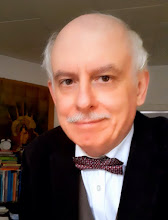
- The Subterranean Review
- Education: Rotterdam Conservatory, Cambridge University // Activities: composition, writing
Friday, 3 July 2026
Cancel culture

Schoenberg's dualism
For Arnold Schoenberg 12-tone composition became a way for the composer to master the chaotic noise of nature through the laws of the organized composition. In “Theory of Form” (1924) he writes:
[O]ne must . . . in all circumstances, use force on nature, on the material—sounds: that one must force them to keep to a direction and a succession laid down by us. One has to force nature—the material—by means of nature—our way of thinking—to work naturally according to our nature; otherwise, we can either not grasp it or else, if one lets the sounds run as they please, it remains a children’s game, like electrical experiments with elderberries or tobogganing or the like. Every more developed game comes about because the course of nature is modified by a force from the outside.
This is the result of the dualist thinking that 'the mind' and 'nature' are entirely distinct and separated entities, that there are no relations between the two, a thought going-back to René Descartes, the 17C French philosopher who influenced scientific thinking so strongly, who insisted upon a fundamental split between the two. However, it became a basic tenet of Western science and scientific thinking, with its ideas of progress, speculation and discovery, and was something that Schoenberg found very inspiring.
So, Schoenberg thought he could construct a system with its own logic unrelated to the physical reality of sound, which is defined by the harmonic series and to which the receptive system of our ears and brain is related because both are the result of evolution. However, humans are part of nature, and their mind is also part of nature.
Thursday, 2 July 2026
AI has opinions
AI’s opinion about John Borstlap:
-------------------------------------------------------
Composer and author John Borstlap has received a polarizing critical reception, with his traditionalist approach to classical music drawing both deep praise for preserving artistic beauty and harsh criticism for perceived artistic conservatism.
Critical Reception to His Books
Borstlap’s writings, including his 2013 book The Classical Revolution and his 2023 work Regaining Classical Music's Relevance, sparked passionate, divided responses:
- Praise: Some scholars, philosophers, and musicians, such as composer Bright Sheng , have lauded Borstlap for offering a "tour de force" that rescues classical music from academic modernism. Proponents celebrate his arguments that traditional tonal art fulfills core human psychological and spiritual needs.
- Criticism: Conversely, the books have met with fierce pushback, particularly in his native Netherlands and Germany. He has faced devastating rebukes from modernist critics who view his rejection of contemporary, atonal, and progressive styles as an outdated or “heartless” reaction to cultural evolution.
Reception to His Music
As a composer of chamber and orchestral music, Borstlap’s style combines early romantic influences with a contemporary tonal idiom . His compositions, such as his Violin Concerto, have won prestigious international prizes and have been performed by renowned ensembles like the Dallas Symphony and Hong Kong Philharmonic.
· Praise: Supporters like German aesthetic philosopher Andreas Dorschel praise his music for its "highly sensual attractiveness", noting that Borstlap masterfully connects to the classical-romantic tradition without merely copy-pasting past styles. [
· Criticism: Some reviewers have been less receptive, occasionally characterizing his chamber works (such as Hyperion's Dream) as too derivative of Brahms or Schumann. Critics in publications like Gramophone and BBC Music Magazine have sometimes described his stylistic choices as bordering on pastiche, citing a lack of originality when straying from traditional models.
Sunday, 21 June 2026
Schoenberg's problems
Reread bits of Harvey Sachs' admirable and odd biography of Schoenberg, admirable for its extensive research, and odd for its continuous reservations which entirely undermine his obvious aim to place Schoenberg on the pedestal of musical greatness in the pantheon of the Great European Composers.
Relistened to some of S's works on YouTube - the rich library of recordings of anything that ever has been recorded in whatever way. Jacobsleiter, Moses and Aron, First and Second Chamber Symphony, Verklärte Nacht (ravishing recent recording by the Danish National Symphony under Fabio Luisi), Pierrot Lunaire (the best recording available is with Jan DeGaetano).
Schoenberg was a composer of genius, as can clearly be heard in his early works, and in his astonishing, expressive originality in his 'middle period' of 'expressionism'. He plumbed the depth of his own subconsciousness, and further down, the collective subconscious (the territory as described, later-on, by C.G. Jung), as he said it himself: the artist should delve into his subconscious to present to the world a reflection of what is going-on behind the façade. Well, what he found was a world of angst, destruction, hysteria, where the forces of coherence and order were loosened and finally abandoned (as in Erwartung). In the beginning of the 20th century, the world of 'Old Europe' was dissolving and a 'modern world' was born, beginning with a devastating war that the world had never seen before - thanks to technological progress. The utmost barbarism in combination with sophisticated technology was a signal that this modern world was not at all what the 19th century so optimistically had dreamed-up ('il faut être absolument moderne!' as Rimbaud claimed).
In the sobering coolness of the twenties, a 'return towards order' became the new ideal for new music, reaching-back to pre-19C music which was seen as a haven of objective enjoyment instead of the cultivation of subjective emotion which got a bad name after the harrowing excess of emotion in the Great War. And Schoenberg invented his notorious 12-tone method of composition where dissonance was 'emancipated' and tonality, as a given by nature in the harmonic series, was supplanted by a very different system whereby individual notes no longer made audible sense in the way they made sense in earlier music. It is an entirely artificial approach and a human construct where the natural resonances of tones is denied. Hence the constipated, forced and fragmented effect of 12-tone pieces and the morbid effect of Schoenberg's only 'comic' opera 'Von Heute auf Morgen' where the only thing that is comical, is the intention to write a comic opera with that system. In fact, Schoenberg himself admitted to a friend after the premiere: 'I have to confess that these sounds make me quite depressed'.
Yet, it is clear to anybody with a musically-sophisticated ear that Schoenberg was a genius in terms of talent, alas he seems to be the only great composer thus far who got stuck in intellectual frustration. As such, he remains a strong symbol of what went wrong in 20C music. At heart he was a traditionalist, admiring 'the masters' to bits, and trying to save tradition from vulgarity, as he saw it, by taking distance from the 'normal chords' which - in his opinion - had become trivialised by the popular music of the time. But musical material is not vulgar in itself, it is the context that may trivialise chord, melodies, rhythms - his thinking was literal, materialistic, rationalistic. Also his claim that he emancipated the dissonance (as he called it) is a misconception because a dissonance is not a thing that can be emancipated, but is an effect within a musical context, dependent upon style, aesthetics, etc. etc. Reading Schoenberg's comments upon the great German tradition, one begins to see what his problem was: he looked at those brilliant works mainly in an intellectual manner, and concluded that it was their complex and sophisticated structuralism that made the music 'great'. And that is a nonsensical notion. But it shows that at heart, he wanted to be a classicist, but did not know how to manage that in a time saturated with ideas of progressiveness and modernity as inspired by science, which stood in stark contrast to the musical aesthetics of the 18th and 19th century. He could have discovered the nonsense of such ideas and follow his heart, but that went against his rationalism. And thus, he committed artistic suicide, and never became the Great Composer he always felt he had to be, or maybe already was. I think: that notion was a real potential, unexplored.
Premiere in Concertgebouw Amsterdam
On 29th of October 2025 the superb Italian/Slovene Alinde Quartett presented the Dutch premiere of my - thus far - only string quartet: 'Traum, Lenz, Verwandlung' in the Concertgebouw. The Alinde Quartett belongs to the international top level of chamber music ensembles, with great performances and recordings of the classics but also including new works into their programs. They are 'Ensemble in Residence' of the Philharmonie in Cologne and draw an enthusiastic audience to their concerts in various European venues.
https://www.alindequartett.com/
I feel deeply honoured by the serious dedication of these young players, who have added the quartet to their repertoire, and who have asked me to write a short piece for one of their Schubert concerts - 2028 is the memorial year of the death of this great composer who worked in the shadow of Beethoven and yet found his own, authentic voice.
The concert in the Concertgebouw - the Alinde's debut in the country - was recorded for national radio, and was, in total, a success. There was no review, in the Netherlands such concerts don't draw much attention, and since I do not have a particular high opinion of Dutch criticism of classical music concerts I'm quite happy with that.
'Traum, Lenz, verwandlung' (1997) was written in a period of almost total isolation, without any performance or players in mind, and the result of finding a short sketch of years earlier for a film project of a young filmmaker (which did not come to fruition). The material invited for further elaboration and thus, the music wrote itself, so to speak, unhindered by any conscious consideration as to the musical world. Some 10 years later a Romanian immigrant quartet tried to play it in the chamber music series of the Amsterdam Stedelijk Museum (museum for modern art) but that did not go well, and they complained (!) that the music was 'like late Beethoven'. A couple of years later a young British quartet tried it at a concert in London's Kings Place chamber music series but failed; I was not present but friends' stories reported something like a public rape. Later attempts to interest Dutch quartets all failed - no interest. What a contrast to find a quartet at an international top level who could manage their parts in a very impressive way and with great musical insight.... only now the music came into its own.
The music of the quartet, although not easy at all to play, is not 'difficult on the ear' and draws inspiration from the existent classical quartet repertoire, but transforms these influences into a language a bit reminiscent of early 20C music of the Germanic cultural sphere. I remember having thought at the time: what would Schoenberg have written if he had renounced his ideas of atonality and progress, and simply had followed his inclinations? All speculative of course, but I found it a fascinating idea which has stimulated me oftener.